
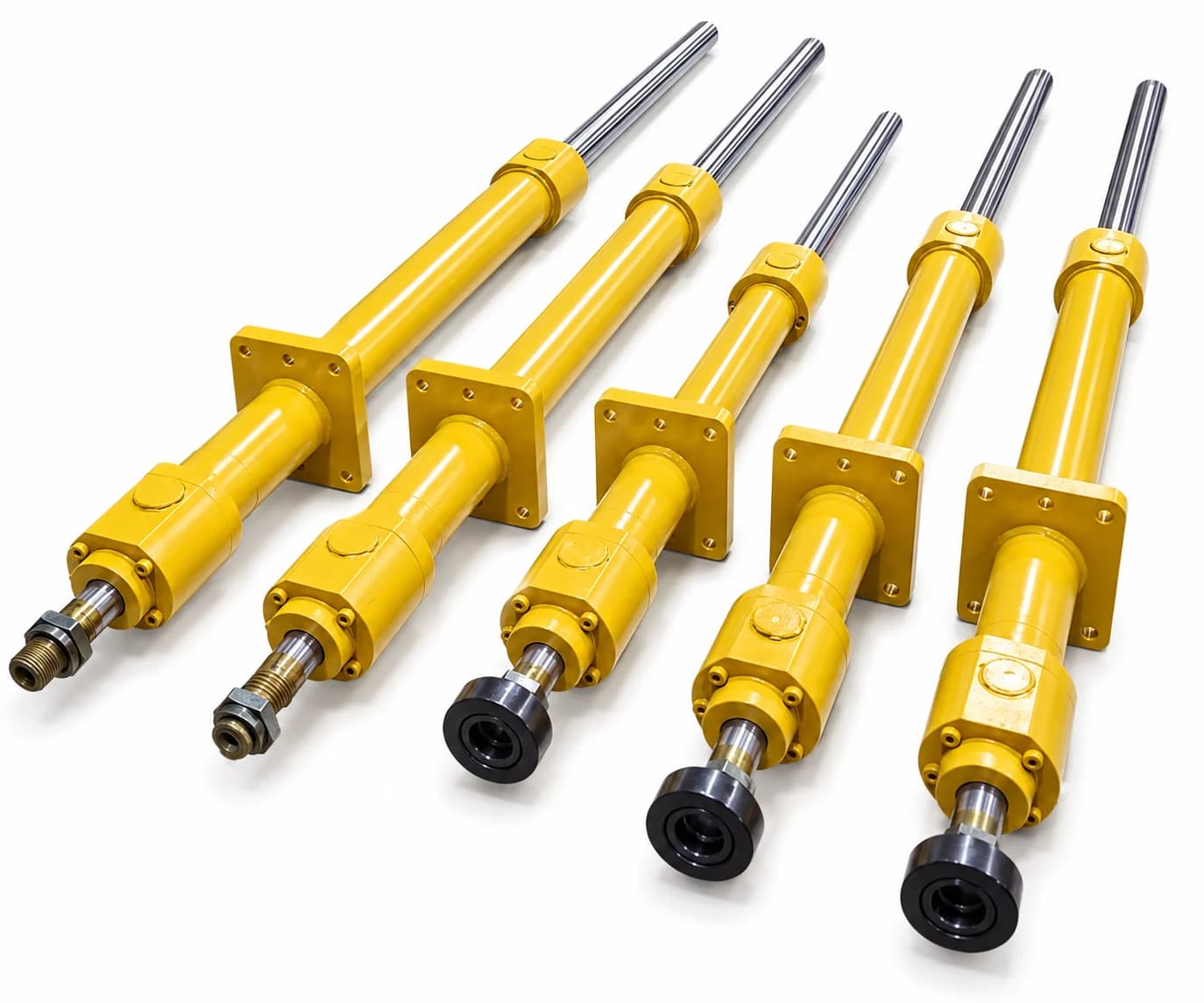
The Engineering Triad: Pressure, Velocity, and Thermal Compatibility
In heavy-duty industrial hydraulic cylinders, the dynamic sealing interface is the most critical micro-mechanical boundary in the entire system. A high-tonnage hydraulic cylinder can feature precision forged steel end caps and seamless honed barrels rated for 500 Bar, yet a single thermal degradation or extrusion failure of an elastomeric seal brings an entire plant production line to a halt.
Modern fluid power engineering rejects generic "rubber seal kits." Every dynamic rod seal, piston seal, and static O-ring must be engineered against an exact triad of operational constraints: system peak operating pressure, dynamic linear stroke velocity, and the continuous fluid temperature envelope.
Seal Material Comparison: Polyurethane (TPU) vs PTFE vs Viton (FKM) vs Nitrile (NBR)
Selecting the optimal polymer or elastomeric compound is the foundation of long-term cylinder reliability. Below is the engineering comparison matrix for the four dominant industrial seal compounds:
| Material Compound | Pressure Rating | Max Velocity | Temp Range | Core Strengths & Applications |
|---|---|---|---|---|
| Polyurethane (TPU / CPU) | Up to 400 Bar | 0.5 m/s | -35°C to +100°C | Exceptional mechanical tensile strength, extreme tear resistance, superior resistance to extrusion nibbling. Standard choice for earthmoving and industrial press cylinders. |
| PTFE Bronze Composites (Teflon) | Up to 600 Bar (with backup ring) | Up to 15.0 m/s | -50°C to +200°C | Near-zero breakout friction, complete immunity to stick-slip shudder, exceptional chemical inertness. Standard for high-speed automated actuators and servo-cylinders. |
| Fluoroelastomer (Viton / FKM) | Up to 250 Bar | 0.5 m/s | -20°C to +200°C | Extreme high-temperature resistance and chemical compatibility with synthetic fire-resistant phosphate ester fluids (HFD-R). Required in steel rolling mills, die-casting, and foundries. |
| Nitrile Rubber (NBR / Buna-N) | Up to 160 Bar | 0.5 m/s | -30°C to +100°C | Low-cost general purpose elastomer with excellent elastic memory. Primarily utilized for static O-rings and low-pressure pneumatic/hydraulic actuators. |
The Mechanics of Seal Extrusion: Why Backup Rings Save High-Pressure Seals
Under high hydrostatic pressure (> 200 Bar), elastomeric seals act virtually like incompressible viscous fluids. The pressure forces the heel of the seal into the microscopic radial clearance gap between the piston OD and barrel ID (or between rod gland ID and rod OD).
This dynamic creates extrusion nibbling: as the cylinder cycles back and forth, the extruded elastomer is chewed off along the trailing edge, leading to rapid seal disintegration within hours of commissioning.
To eliminate extrusion failure at elevated pressures, Honeywell Hydraulics designs precision machined grooves to house anti-extrusion backup rings fabricated from high-modulus polymers:
- Virgin POM (Polyacetal / Delrin): High shear modulus, rigid backup ring standard up to 350 Bar.
- Virgin or Carbon-Filled PTFE: Outstanding thermal resistance up to 200°C with self-lubricating properties.
- Hard Thermoplastic Polyesters (Hytrel): Excellent cyclic fatigue resistance under severe pressure pulsing.
Micro-Finish Standards & Forensic Seal Failure Diagnosis
The lifespan of a high-pressure seal package is governed entirely by the surface finish of the dynamic counter-surface. Polishing surfaces too smooth ($Ra < 0.05\,\mu m$) prevents fluid lubricant retention, leading to dry lip chatter; polishing surfaces too rough ($Ra > 0.4\,\mu m$) turns microscopic asperities into miniature abrasive files that shred seal lips.
Honeywell Hydraulics Manufacturing Surface Finish Standards:
- Cylinder Barrel Bore (ID): Honed to $Ra = 0.20$ to $0.40\,\mu m$ with cross-hatch honing pattern ($Rz \le 1.6\,\mu m$).
- Hard Chrome Piston Rod (OD): Ground and super-finished to $Ra = 0.10$ to $0.20\,\mu m$ ($Rz \le 1.0\,\mu m$).
- Static Seal Grooves: Turned to $Ra = 1.6$ to $3.2\,\mu m$.
Forensic Failure Checklist:
- Dieseling (Explosive Decompression / Micro-Dieseling): Characterized by localized black charred or burned craters on the seal face. Caused by entrapped air bubbles that superheat and ignite under instantaneous high pressure spikes (reaching 1,000°C+). Resolved by proper circuit air bleeding.
- Thermal Hardening: Seal becomes brittle, loses rebound flexibility, and develops transverse cracks on the dynamic sealing edge. Caused by bulk fluid temperatures exceeding 70°C. Resolved by upgrading to Viton (FKM) or adding oil cooling.
- Flank Scoring: Longitudinal abrasive grooves along the sealing contact lip. Caused by solid metal chips or sand particles bypassing the wiper seal. Resolved by upgrading to a double-lip polyurethane metal-cased wiper.